

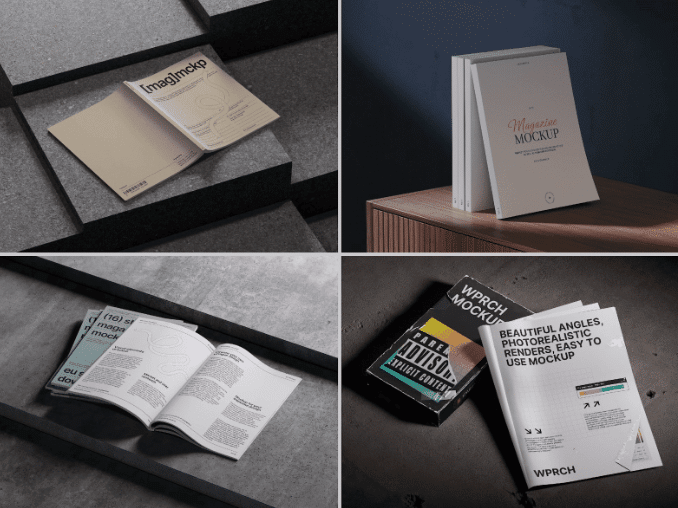
A magazine mockup is a pre-built photorealistic template that lets you place your design into a staged scene — no camera, no printer, no photo studio needed. It simulates how a real printed magazine looks in the physical world: light falls across the cover, paper has texture, shadows make it feel grounded. Designers use them to present work to clients, build portfolios, and test ideas before anything goes to print.
Most designers use magazine mockups once — drop in the cover, export, done. But that’s barely scratching the surface. A well-made mockup is a full creative tool, and the best designers think way beyond the obvious.
1. Pitching Editorial Concepts to Clients
Before a single page goes to print, a mockup sells the vision. A realistic render communicates tone, brand voice, and layout strategy faster than any written brief. Show clients what their publication could feel like — not just what it looks like on a flat artboard.
2. Building Social Media Content
Print aesthetics are thriving on Instagram and Pinterest. Instead of organizing a physical shoot, stage editorial flat lays digitally with a magazine mockup. It’s content creation and design practice at the same time.
3. Showcasing Interior Spreads
Cover design gets all the attention, but spread layouts are where real editorial skill shows. Open-spread mockups display your grid logic, typographic hierarchy, and photo direction in a way flat exports never can.
4. Presenting Brand Identity Systems
Put a new brand inside a magazine environment and immediately see how it performs at scale. Does the logo hold at small sizes? Does the palette feel authoritative on coated stock? Mockups answer these questions before production begins.
5. Building a Portfolio Without Real Clients
You don’t need paid work to build a compelling portfolio. Create fictional publications for industries you want to break into:
- Fashion and beauty — editorial spreads that rival high-end glossies
- Food and lifestyle — recipe layouts and product stories
- Architecture — spatial narratives in a publication context
- Finance and tech — making dense information feel premium
Placed inside a quality mockup, the work looks indistinguishable from commissioned projects.
6. Testing Typeface Pairings
Typography that looks right on screen can fall apart in print. Mockups bridge that gap — helping you evaluate headline and body copy interactions at reading distance, under ambient light, on simulated paper stock.
7. Creating Educational Content
Design educators and course creators can use magazine mockups to teach layout principles in context. Showing kerning, bleed margins, or visual hierarchy inside a real publication environment makes abstract concepts click.
8. Presenting Annual Reports
Annual reports are magazines with spreadsheets. A mockup-based presentation gives corporate clients a tactile feel for what their publication will become — far more persuasive than raw layout files, and better at bridging the gap between designers and non-designer stakeholders.
9. Selling Digital Publications Online
Listing a digital zine or magazine on Etsy or Gumroad? A staged mockup image gives your product physical presence. Buyers emotionally connect with something they can visualize holding — and that directly affects conversion rates.
10. Exploring Color and Mood Before Committing
Use mockups as a rapid creative lab. Test dark versus light cover treatments, bold versus muted palettes across a series, seasonal variations:
- How does the masthead hold up across twelve months of covers?
- Which color system reads as premium, and which feels generic?
Real-World Examples
A London branding studio used open-spread mockups to pitch a hospitality rebranding as an imaginary in-room guest magazine — client approved in the first meeting. A Brooklyn freelancer built her entire portfolio around fictional publications and tripled her inquiry rate. In Melbourne, a design school integrated mockup presentations into their curriculum, and students immediately began thinking about typography as reader experience rather than pure aesthetics.
Premium Magazine Mockups on ls.graphics
Not all mockups are equal — and the quality of your mockup reflects the quality of your work. The magazine mockup collection on ls.graphics is built with genuine craft that shows in every detail:
- Ultra-realistic rendering — light, shadow, and paper texture behave like the real thing, not like a digital approximation
- Organized, clean layers — no hunting through a tangled layer stack; the file structure is logical and designer-friendly from the moment you open it
- Multiple angles — flat lays, three-quarter perspectives, hand-held editorial shots — choose the presentation style that fits your project’s personality
- Various color styles — match the scene’s environment to your design’s mood rather than forcing your work to adapt to a fixed aesthetic
- Stylish minimalistic compositions — no visual noise competing with your design, just clean staged scenes that let your work own the frame
- Effortless to use — drop in your design via smart object, hit save, and you have a presentation-ready visual in minutes
Conclusion
A magazine mockup is only as limited as how you think about it. Portfolio building, client pitching, social content, education, e-commerce — the use cases multiply once you stop treating mockups as a final step and start treating them as a creative environment. The best mockup disappears, and your audience simply sees your design living in the world. That’s the standard ls.graphics has set — and why designers keep returning when the stakes are high.


