

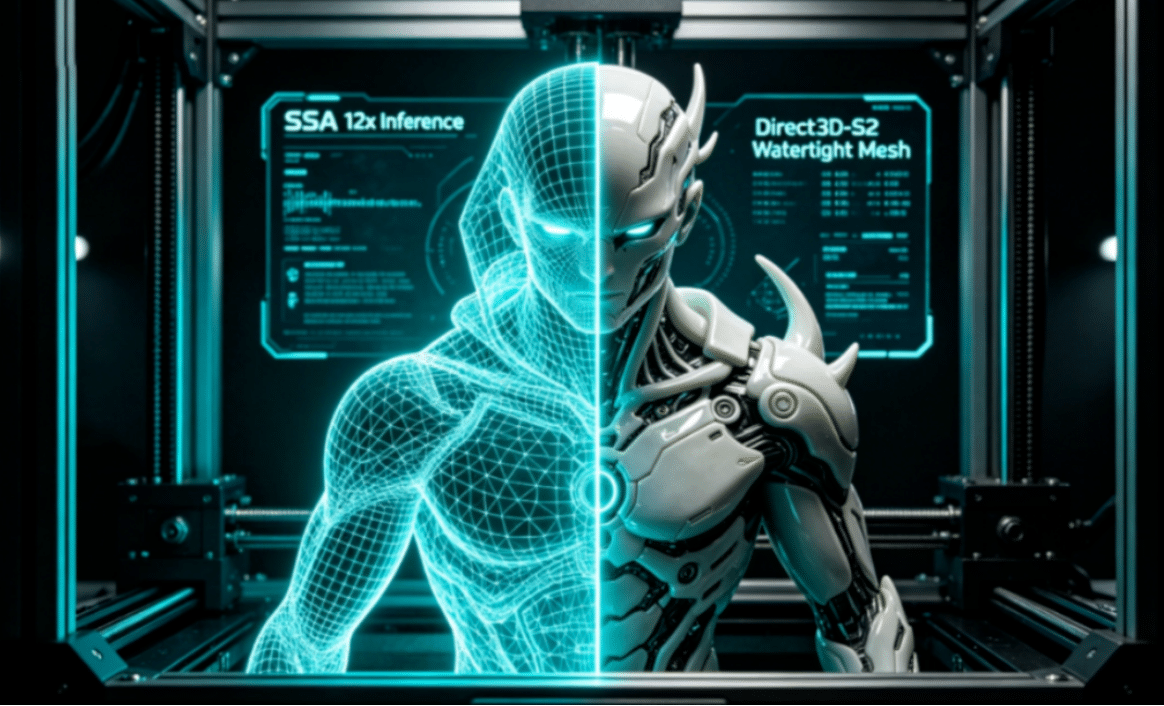
For many developers and fan-creators, the most significant hurdle in merchandising isn’t the artistic vision-it is the engineering transition from a 2D digital illustration to a physical product. In the urban-mythology landscape of titles like Dislyte, character designs are complex, featuring intricate mechanical accessories and gravity-defying silhouettes. Turning these into high-end physical collectibles traditionally requires months of manual 3D sculpting and iterative prototyping. However, the emergence of an automatic STL generator within the Neural4D ecosystem is fundamentally shortening this lead time, allowing studios to scale from “concept art” to “shelf-ready prototype” in a fraction of the time.
Founded on research from laboratories like Oxford and DreamTech, Neural4D serves as an industrial-grade bridge between creative software and the manufacturing floor. Its Direct3D-S2 architecture is specifically designed to move past visual approximations toward mathematically sound, production-ready geometry.
The Bottleneck of Game Merchandising
Physical production has historically been the “slow lane” of the gaming industry. While digital assets can be patched and updated instantly, physical prototypes involve:
🎯 Lead Time Friction: A single hand-sculpted prototype of a complex character can take 4–6 weeks to reach a “manufacturable” state.
🎯 Geometry Errors: Standard AI tools often output “non-manifold” meshes-files that look correct on screen but contain holes or overlapping faces that cause industrial 3D printers to crash.
🎯 Cost of Failure: Every failed print or mold iteration represents a loss in material and production window, directly impacting the ROI of a merchandise line.
By utilizing the automatic STL generator capabilities of N4D, designers can bypass these manual bottlenecks. The system processes the 2D reference and reconstructs a high-fidelity 3D volume that respects the constraints of physical space.
Engineering the “Perfect Print” with Direct3D-S2
The core requirement for any physical merchandise, whether it is a resin figure or a bespoke piece of furniture, is watertight geometry.
✅ The Watertight Standard
Many generative tools produce “triangle soup” – a disorganized cloud of polygons that lack structural integrity. Neural4D utilizes native volumetric logic to ensure every output is watertight. This means the mesh is mathematically closed, allowing it to pass through industrial slicers like Chitubox or Cura without requiring manual hole-patching.
✅ Quad-Dominant Edge Flow
For high-end collectibles, “good enough” isn’t sufficient. The Direct3D-S2 engine prioritizes quad-dominant structures. This clean edge flow allows industrial designers to easily perform subdivisions or modify specific mechanical joints on the model before sending it to the factory floor.
Precision at Scale: SSA and Industrial Topology
Scaling a merchandise line means producing dozens of assets simultaneously. In a studio environment, manual modeling cannot keep pace with a rapid release schedule.
⚡ 12x Inference Acceleration
The implementation of Spatial Sparse Attention (SSA) allows N4D to achieve a 12x speed increase in generating high-resolution meshes. This architectural shift means that an entire “Esper” lineup can be processed via batch inference overnight, delivering 2048³ resolution geometry that captures the fine mechanical details of urban-industrial armor or ornate mythological weapons.
⚡ Computational Efficiency
By reducing the computational overhead, N4D enables smaller studios to compete with industry giants. The system handles the heavy lifting of geometric reconstruction, allowing the human artist to focus on the final 5% of aesthetic polish rather than the initial 95% of foundational construction.
PBR Workflows: Providing the Factory Blueprint
Manufacturing physical goods requires a precise reference for texture and material. A PVC figure needs to replicate the specific metallic sheen or matte fabric seen in the game’s art.
🎯 Pure Albedo and Material Clarity
Traditional AI generation often “bakes” lighting into the texture, which misleads factory color-matching. Neural4D generates pure albedo textures, separating the color data from environmental lighting.
🎯 Industrial Material Maps
Alongside the geometry, the AI Texture module outputs necessary Normal, Roughness, and Metallic maps. This PBR workflow provides a technical blueprint for the manufacturing plant, ensuring the final physical product matches the digital vision in terms of light reaction and material quality.
Conclusion: Closing the Virtual-to-Physical Loop
In the competitive landscape of game-based manufacturing, speed and precision are the only metrics that matter. By integrating an automatic STL generator into the production pipeline, developers can transform a 2D sketch into a physical prototype with zero latency. Neural4D isn’t just an AI tool; it is a manufacturing-grade engine that bridges the gap between digital mythology and physical reality, ensuring that every asset is engine-ready and printer-ready from the moment of generation.


